

Carbon accounting has spent years focused on understanding a company’s emissions. But the overall company footprint of a supplier doesn’t offer much in scope 3 calculations, where emissions are measured at a product level.
This has real implications for how manufacturers need to approach both sustainability and their customers’ procurement processes. As customers come under increasing pressure to report scope 3 emissions data, they will turn to you for product carbon footprints (PCFs). No more rough estimates or approximations: auditable, standards-compliant figures they can put in front of a regulator or auditor. If you can’t do that, you’ll have to balance it out by cutting prices or even risk losing the deal altogether.
There's a growing market of PCF tools to help you do this, but not all PCFs are created equal. There are meaningful differences in methodology, data quality, and standards compliance between what's out there, and those differences matter to your customers and your reputation.
In this post, we'll walk through what to watch out for when evaluating PCF tools, and why our PCF Studio's independent ISO 14067 verification sets a new bar for what "production-ready" looks like in this space.
Most of your customers will need a cradle-to-gate PCF, which accounts for emissions associated with a product from raw material extraction through to the point of purchase. That means materials and components, yes, but also the energy consumed in manufacturing, and the freight required to move inputs through your supply chain. If you need to move a few tons of aluminium across the world to build your product, it will likely have a big carbon impact.
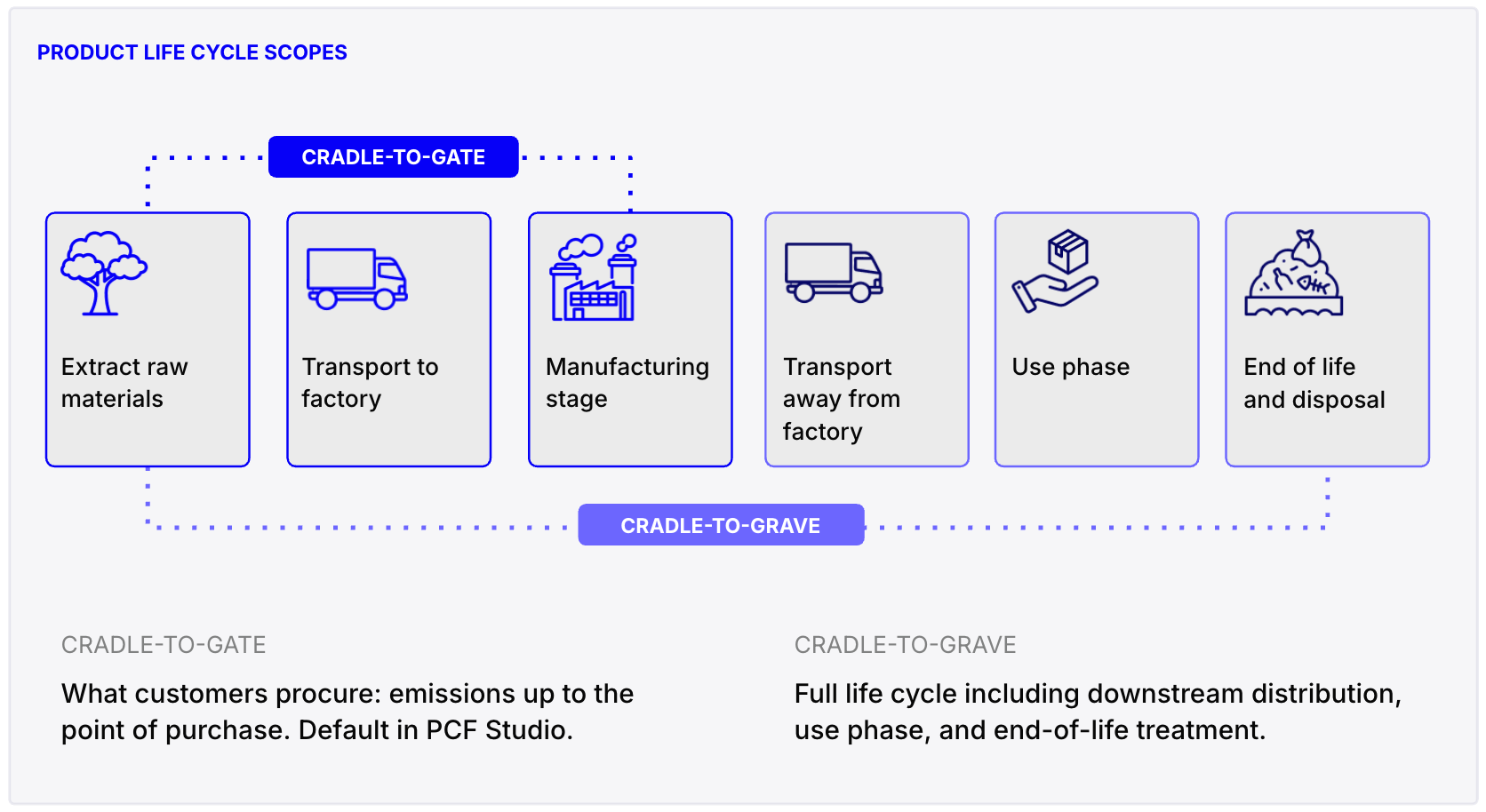
However, a surprising number of tools on the market don't deliver this. Many stop at the bill of materials: multiply an emission factor by the weight of each component, sum the results, call it a PCF. It's a reasonable starting point, but it's not a PCF in any meaningful sense.
The energy, heat, and industrial processes that actually turn raw materials into a finished product can represent a significant share of a product's total footprint. Freight, depending on your supply chain, can be substantial too. For a customer using your PCF in their reports, an incomplete figure creates a credibility risk that can have a major impact on your relationship.
Equally problematic is the rise of AI-generated PCFs with no human oversight. Some tools lean heavily on automated outputs with little transparency into how figures were derived and no ability for users to review, verify, or correct them. Regulatory standards require traceability and documented methodology; a black-box AI output doesn't meet that bar.
A PCF is only as trustworthy as the inputs and logic that produced it.
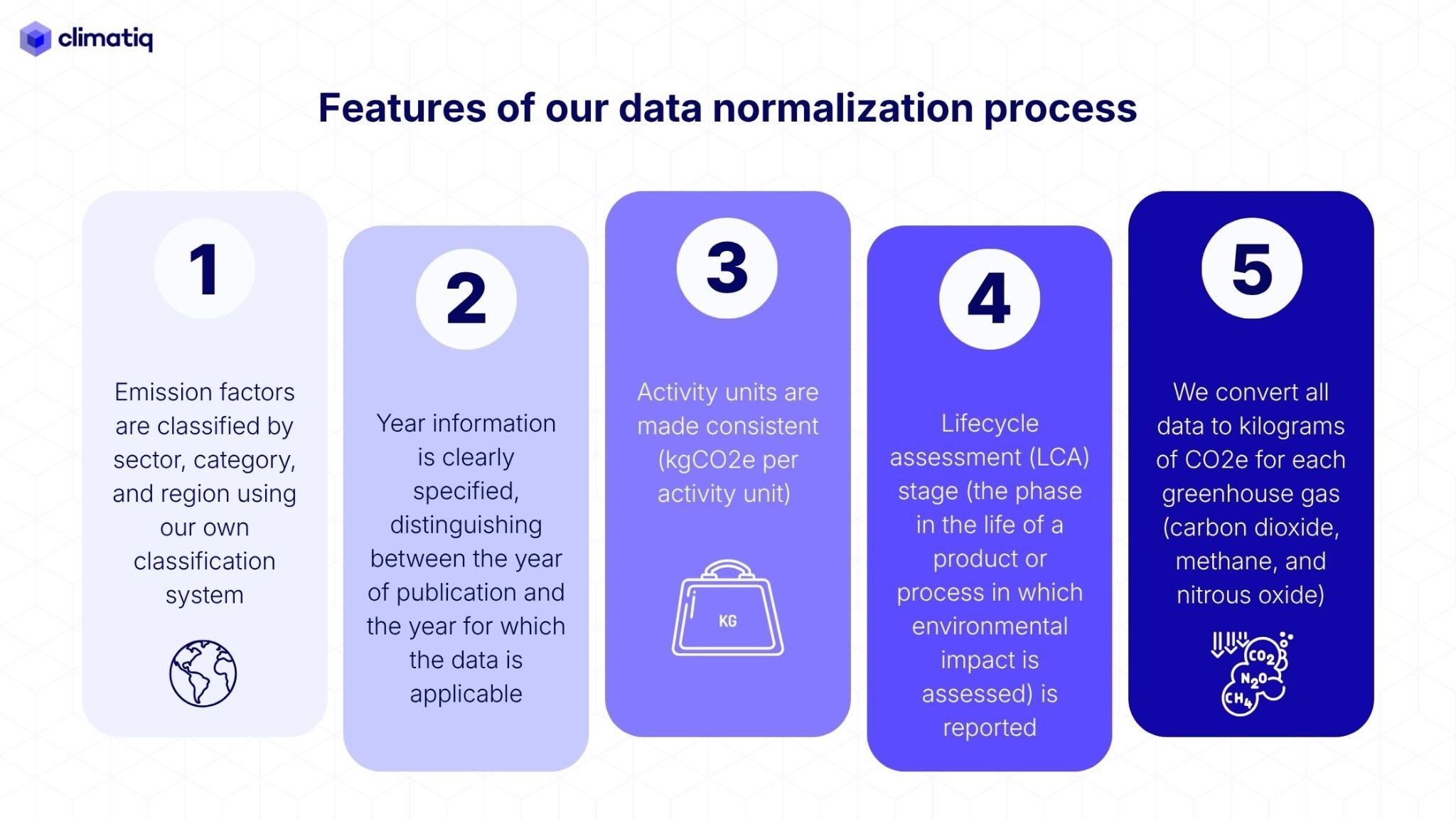
In any PCF calculation you’ll need emission factors. The problem is that emission factors come from dozens of different sources—government agencies, LCA databases, research institutions—each with their own methodologies, units, and system boundaries. Vetting ensures the data is scientifically sound; normalization ensures the factors are compatible with each other. It's painstaking work, which is why many tools skip it. For a deeper look at what rigorous emission factor curation involves, see our blog post on how we built a 1-million-factor database of scientifically-verified emission factors.
Even with good data, it’s critical to understand how it’s being used. Using a verified methodology ensures calculations are sound and repeatable.
ISO 14067 is the international standard for quantifying and communicating product carbon footprints, and certification is meaningful precisely because it requires external verification from multiple auditors. Climatiq's PCF API, which powers PCF Studio, is verified against ISO 14067 and the GHG Protocol Product Life Cycle Standard. That matters for you as a user, because it means the PCFs you produce will carry the credibility your customers need to see.
When a customer's auditor comes calling, they won't just accept a number. They'll want to know which emission factors were used, where they came from, data quality indicators, and the calculation methodology. Without that, there's no meaningful difference between a tool-generated PCF and a figure someone retrieved from a chatbot. It could be plausible-sounding, but if it’s impossible to verify and potentially different every time you ask, you are going to have major problems.
An audit trail allows a PCF to be replicated, reviewed, and trusted. Without it, your customers can't use the figures you provide to meet their reporting obligations, which makes the exercise pointless for both of you.
PCF Studio surfaces the full picture behind every result: the emission factors applied, their IDs, associated data quality indicators, and the methodology used in the calculation. Nothing is a black box.
The entire point of a PCF is that it reflects the reality of how a specific product is made, what it's made from, and how it moves through a supply chain.
Spend-based carbon accounting works in the opposite direction. It estimates emissions by applying average factors to monetary spend, which means it can't distinguish between two similar products that cost the same but could have entirely different materials, manufacturing processes, or supply chains. A low-carbon and a high-carbon product from the same category, priced identically, will produce the same estimate.
If a supplier offers you a discount, your estimated emissions fall even though nothing about the product has changed. If raw material costs rise, your footprint goes up, with no change in emissions produced. In practice, spend-based methods can make cheaper products look greener, which is often the opposite of the truth.
For corporate carbon accounting, spend-based estimates are a reasonable starting point. For a PCF, where the whole purpose is to provide a product-specific figure, they're not fit for purpose. Climatiq never uses spend-based emission factors in PCF calculations.
Granular PCF calculations often require access to premium datasets like ecoinvent, CarbonMinds, sustamize, and others. Many tools expect you to source and license these yourself, which means procurement conversations, legal review, external validation, and back-and-forth emails before you can even start on the calculation. For a customer request with a tight turnaround, that's a serious problem.
Even once you have access to the dataset, you’ll need to normalize the data to make it usable alongside any other sources you have, which is again a very timely and complicated process.
Climatiq handles licensing for premium datasets directly, so there's no separate procurement process and no waiting. And of course, everything is normalized to a consistent standard across the board so datasets can be mixed and matched. Because the data is already integrated into the platform, it's ready to use from day one.
Before committing to any tool, you should be able to use it yourself, with your own data, on your own terms, without a guided demo or a sales rep holding your hand. That's how you know whether it works for your products and workflows, and whether your team can adopt it without significant support.
If a vendor tells you that their tool is easy to use, but they won't let you try it independently, their actions are probably more important than their words. That will impact how quickly you can get up and running and respond to customer requests at short notice, and how you can scale PCF delivery across your team.
To prove how easy it is for you to get started with PCF Studio on your own, the first five PCFs you create in PCF Studio free. You can sign up, bring your own data, and see exactly what the tool produces in minutes.
PCF Studio is built for manufacturers who need to move quickly but without cutting corners. You don't need prior carbon accounting expertise to create your first PCF, but you can still stand behind every figure you produce, because the methodology, data, and audit trails are there to back you up.
Under the hood, it's powered by the world's largest database of verified emission factors and the same certified calculation engines that underpin Climatiq's energy and freight APIs: tried, tested, and verified to meet the ISO 14067 standard. That's what a PCF needs to be to be useful and win customers, rather than just a number you use to put in a form.
You can start calculating with PCF Studio here.


.svg)


